
Do you feel like your English reading is excellent, but your speaking lags behind? You aren’t alone. Many Chinese speakers are “visual learners” when it comes to English—processing information through text rather than sound.
Think of it like learning the piano. You can memorize the music theory and read the sheet music perfectly, but until you train your fingers to move, you cannot play the song. Language is the same: you may know the grammar rules, but you need to train your mouth and ears to “play” the language.
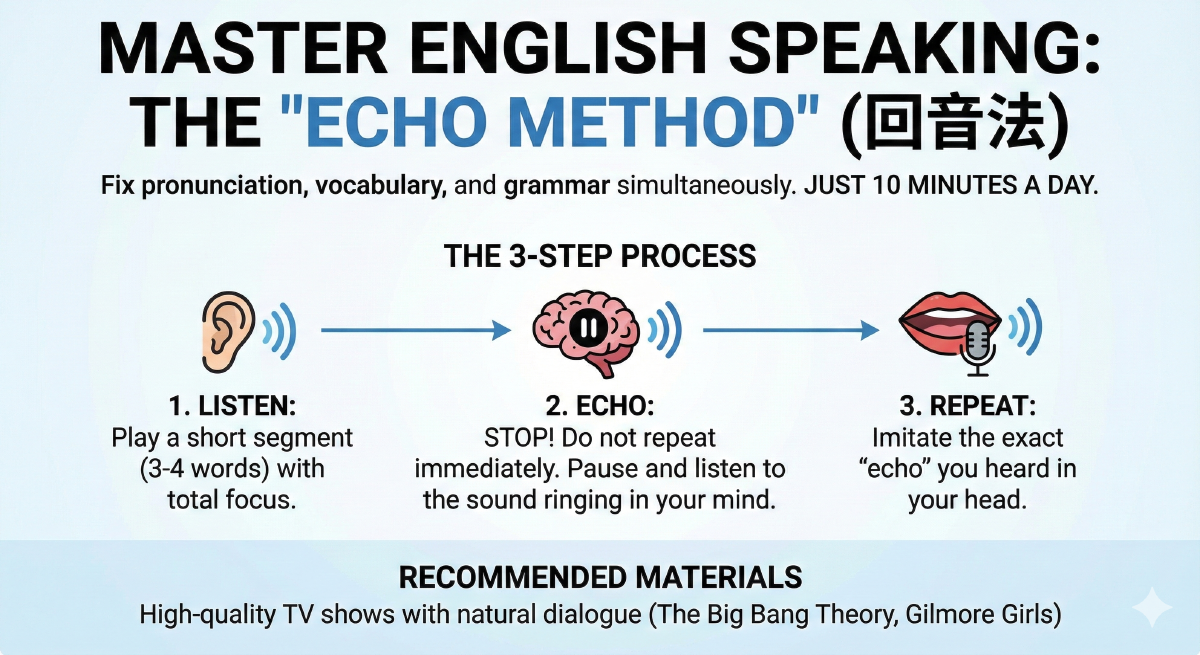
Here is a simple, effective technique called the Echo Method (回音法) that fixes pronunciation, vocabulary, and grammar all at once.
★The Cognitive Gap: Reading vs. Hearing #
Because Chinese characters are logograms, Chinese speakers are incredibly efficient at visual processing. You can scan a text and grasp the meaning instantly, skipping over the “sound” of the words.
However, English is an auditory language. It relies entirely on:
- Correct Vowels
- Correct Consonants
- Correct Stress
If you skip the sound processing, you lose the meaning.
★It’s Not Just an “Accent”—It’s Meaning #
Many learners think, “I have an accent, but people understand me.” But often, what we call an “accent” is actually a misuse of phonological rules that changes the meaning of words.
◇The Vowel Length Rule #
In English, the length of a vowel changes depending on the sound that follows it.
- If a vowel is followed by a voiced consonant (like d, b, g), the vowel gets longer.
- If it is followed by an unvoiced consonant (like t, p, k), the vowel is shorter.
The Common Mistake: Most learners are not taught this, so they pronounce “bat” and “bad” with the exact same vowel length.
- Bat (short) vs. Bad (long)
- Bet (short) vs. Bed (long)
◇The “Bit” vs. “Beat” Confusion #
Confusion also happens between the vowels /i/ (long) and /ɪ/ (short).
- Eat
/i/vs. It/ɪ/
In Mandarin, we have the /i/ sound (like in “一” yī). But the short /ɪ/ is rare. It sounds like the quick “one” in a military drill (“one-two-one” / 1-2-1).
If you don’t master these distinctions, you might be saying a completely different word than you intend:
- A little bit?
- A little bid?
- A little beat?
- A little bead?
★The Solution: The Echo Method (3 Steps) #
You can fix this with just 10 minutes a day using the Echo Method.
Recommended Materials: Use high-quality TV shows with natural dialogue.
- The Big Bang Theory
- Gilmore Girls
The Process:
- Listen: Play a short segment of the video (just 3-4 words). Listen with total focus.
- Echo (The Critical Step): Stop! Do not repeat it immediately. Instead, pause and listen to the “echo” of the sound ringing in your mind. This utilizes your brain’s “echoic memory.”
- Repeat: Imitate the “echo” you just heard in your head.
By listening to the echo first, you are copying the actual sound, not the memory of how you think the word is spelled.
★Conclusion #
You don’t need hours of study. You need precise, focused practice. By spending 10 minutes a day “echoing” native speakers, you will naturally absorb correct pronunciation, intonation, and grammar.
Watch the full explanation by Karen Chung here: